Beyond the Viral Feed: A Student's Guide to Identifying Astroturfing and Manufactured Content
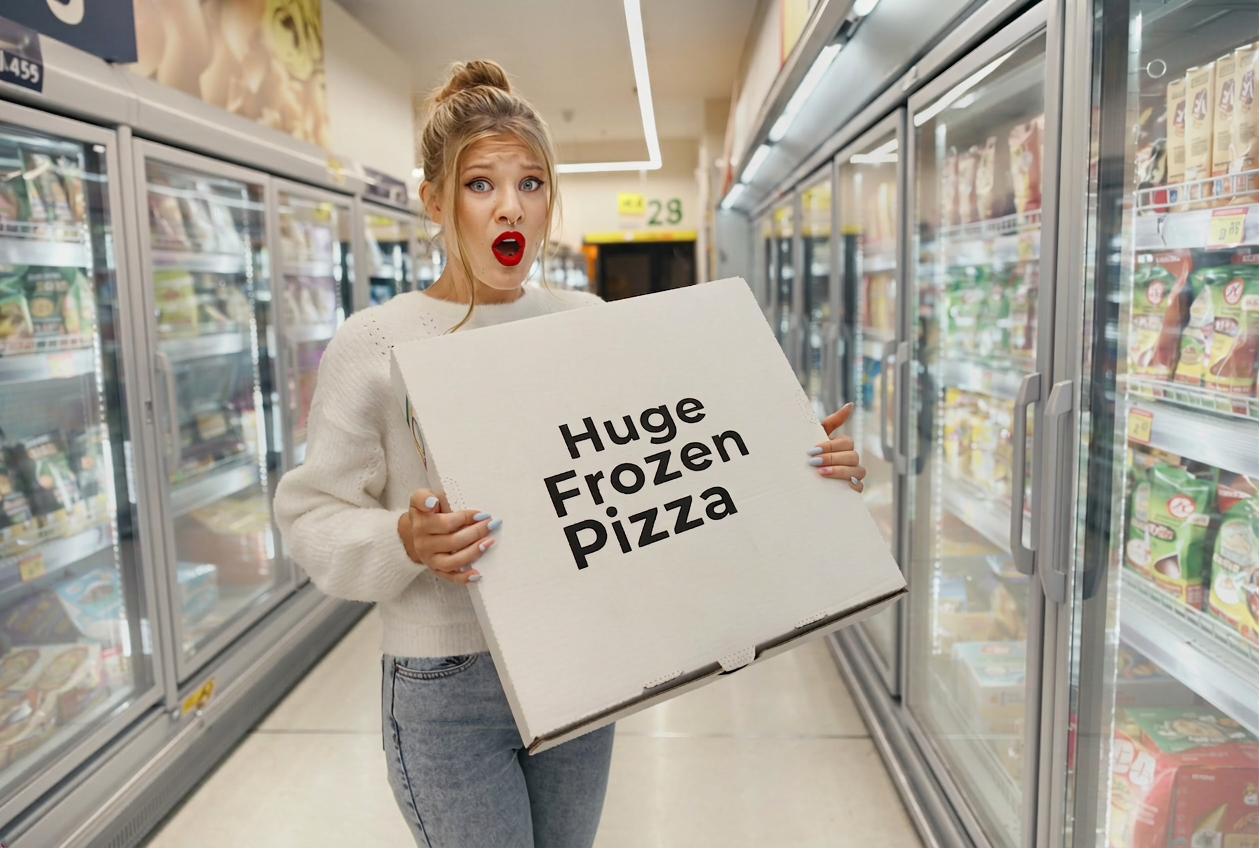
The "stunned tourist" trope.
1. Introduction: The Mirage of the "Stunned Tourist"
In the digital theater of the 2026 World Cup, the global consumer was systematically targeted with "engineered authenticity." This phenomenon is known as astroturfing: the deceptive practice of manufacturing a "grassroots" movement or spontaneous reaction to mask a highly funded, top-down propaganda campaign. By presenting commissioned content as the organic discovery of an outsider, architects of influence bypass the audience’s natural skepticism toward traditional advertising.
The "stunned tourist" trope—an Italian marveling at free soda refills or a Japanese traveler discovering chips and salsa—is the primary vehicle for this manufactured consensus. It transforms a scripted marketing outcome into an "Outsider Verdict," a powerful tool that carries a level of pseudo-objectivity domestic propaganda can never achieve.
Organic Connection vs. Engineered Influence
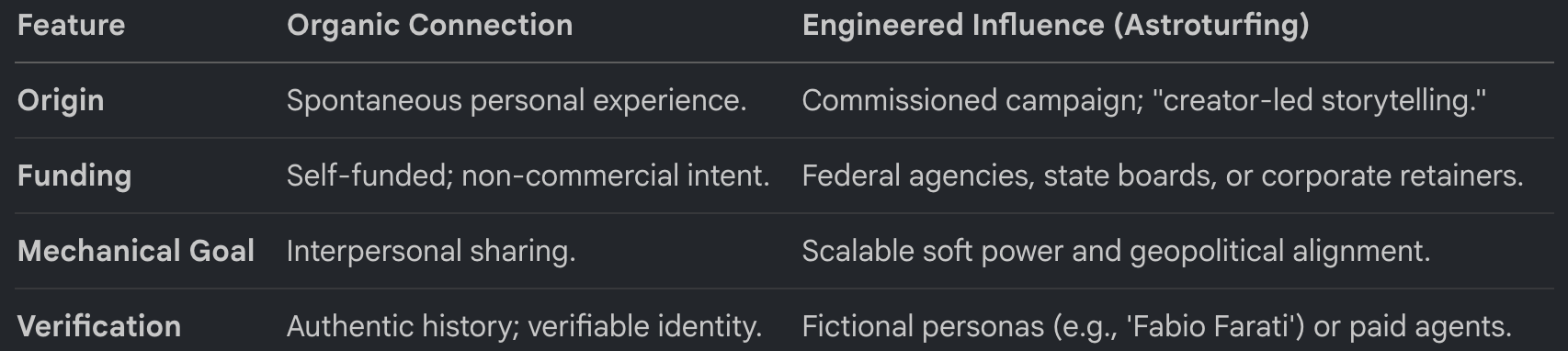
Organic Connection vs. Engineered Influence
The Three Pillars of the "Stunned Tourist" Phenomenon
Fictional Personas: Viral "travelers" are frequently professional comedians or actors (such as 'Nobunaga' or 'Fabio Farati') performing characters specifically designed to maximize engagement through cultural stereotypes.
Emotional Validation: These clips function as an "Identity Signal," triggering tribal pride in American viewers. This makes the content highly shareable, as it confirms pre-existing nationalist beliefs through the lens of a guest.
The Outsider Verdict: Because the validation comes from a non-American source, it is perceived as an objective truth. This "verdict" is strategically utilized to validate the American status quo as a global pinnacle of abundance.
Transition: To dismantle this mirage, we must look past the glowing screen and follow the massive financial engines that drive these curated narratives.
2. The Infrastructure of Influence: Following the Money
The World Cup marketing ecosystem is a high-cost production disguised as a digital quilt of "honest" stories. With a staggering 10.5 billion** projected in overall advertising spend and a U.S. influencer economy reaching **44 billion, the "organic" feel of your feed is the result of a multi-billion dollar industrial complex.
Federal and State Machines
Brand USA: The federal government’s official destination marketing organization. It deployed the "America the Beautiful" campaign and an AI-powered digital hub to systematically "reignite passion" for U.S. travel in key European markets.
NYC/NJ World Cup Host Committee: This body launched the AI "World Cup Concierge" across official city tourism sites, effectively funneling the "unfiltered" visitor experience into a curated, brand-approved environment.
State Tourism Boards: Entities like the Delaware Tourism Office and New Mexico’s "New Mexico True" program operated formal paid-influencer programs, providing sponsored travel in exchange for a calculated number of social media exposures.
Sausage and Soft Power: The Strategic Commodity
Government agencies and the firm M+C Saatchi North America—specifically hired for "creator-led storytelling"—view food as the ultimate "sausage" of soft power. Unlike weapons or direct financial aid, food is a "strategic commodity" that is harder to regulate as a gift and bypasses typical anti-propaganda defenses. By focusing on "Gastrodiplomacy," these campaigns use the universal experience of eating to build political goodwill and a sense of "cultural warmth" that masks harder geopolitical objectives.
Transition: These high-level strategies manifest on your phone as specific red flags that reveal the hand of the state.
3. Red Flag Checklist: Identifying the "Fakes"
Media literacy in 2026 requires a clinical audit of the content we consume. We must analyze whether a video is a personal record or a structural operation.
The Media Literacy Audit
Absence of FARA Registration: Under the Foreign Agents Registration Act, influencers paid by foreign governments must provide a "conspicuous statement" identifying their funding. A lack of this disclosure often signals an illegal information operation.
The "Esther Project" Parallel: Parallel to the World Cup, the Israeli "Esther Project" reportedly paid 14-18 influencers approximately $7,000 per post to promote state interests. If the content seems too polished and the creator is suddenly hyper-focused on national themes, look for a "Bridges Partners" style structural link.
Persona Inconsistency: Does the "tourist" have a history of playing fictional characters? (e.g., Fabio Farati is a known TikTok comedian, not a traveler).
NYT Fact-Check Contradictions: Did the creator claim to be in a city where they were not actually present? Investigative reports often find these "tourists" had returned home weeks before their "live" World Cup reactions were posted.
The "Visa Paradox" and the Authenticity Gap
The U.S. government maintains a strict "Visa Paradox" that ensures only sanctioned voices are heard:
The CBP/DHS Crackdown: Customs and Border Protection officially warned that creating monetized social media content on a tourist visa is "unauthorized work" punishable by immediate deportation and travel bans.
The Sanctioned Elite: While independent foreign creators face travel bans, those working with Brand USA or M+C Saatchi receive legal clearance and sponsorship.
The 39-Country Reality: At the start of the tournament, 39 countries were under full or partial travel bans. The "stunned tourists" you see are the only ones legally permitted to exist because they fit the state-approved narrative of "American abundance."
Transition: These legal and political filters are reinforced by the biological manipulation of the food itself, creating a sensory "hit" that is later amplified by the algorithm.
4. The Science of Taste: Hyperpalatability and Gastrodiplomacy
The viral reaction of a tourist "losing their mind" over a hot dog is often not a reaction to American culture, but a physiological reaction to industrial chemicals. This is the essence of regulatory arbitrage: using substances in the U.S. that are banned in the tourists' home countries to engineer a sensory experience that feels "transcendent."
Regulatory Arbitrage: US vs. International Standards

Regulatory Arbitrage: US vs. International Standards
The 3 Reasons the Hot Dog Tastes So Good
Hedonic Contrast: The high-energy, novel context of a World Cup match amplifies the brain's sensory processing, making a standard product feel extraordinary.
Hyperpalatability: These are industrial formulations that combine fat, salt, and sugar in ratios that do not occur in nature, designed to override satiety signals.
Chemical Engineering: Emulsifiers and flavor enhancers (like brominated vegetable oil) create a "biological hit" to the taste receptors that tourists from stricter regulatory environments literally cannot experience at home.
Transition: This biological "hit" of hyperpalatability is the perfect fuel for the dopamine-driven engine of the social media algorithm.
5. The Algorithmic Engine: Why the Fake Spreads
Manufactured content thrives because platforms are engineered to prioritize "shareworthiness" over objective truth.
Identity Strainer Theory
Identity Signals: Algorithms treat your interaction with pro-nationalist videos as a signal of who you are.
Reinforcement Filtering: The "Identity Strainer" then filters your feed to suppress contradictory information, delivering content that maximizes watch time by validating your tribal pride.
Geopolitical Amplification: Geopolitical interests play a role; studies show that TikTok (owned by ByteDance) has favored nationalist content. Research confirms that Republican-seeded accounts received 11.8% more party-aligned content, while Democratic users were 7.5% more likely to receive GOP-aligned videos than their own preferred content.
The Bill Maher Phenomenon: The Failure of Skepticism
Professional skeptics often become the most effective conduits for disinformation because they prioritize tribal validation over fact-checking.
"Even professional skeptics fall for consumer abundance imagery. Bill Maher's 'Hooray for the USA' segment played these clips as proof of American greatness eight days after the New York Times had already debunked them. This illustrates a total failure of rationalist skepticism; Maher and his audience focused on portion size as a proxy for generosity, ignoring the fact that those 'free refills' contain chemicals banned in the very countries the tourists supposedly came from."
Transition: To reclaim your cognitive autonomy, you must learn to look for the "missing frame" of American reality.
6. Conclusion: Identifying the "Missing Frame"
A literate media consumer asks: What is the camera being pointed away from? The "marketing brochure" version of America shows stadium abundance and clean streets, but it omits the structural disparities that define the host nation.
The Literacy Takeaway
Chemical Arbitrage vs. Culinary Excellence: Recognize that "stunned" reactions are often the result of lab-engineered formulations that treat tourists like lab rats for substances banned abroad.
The $10.5 Billion Operation: Always distinguish between a spontaneous traveler and a state-sponsored marketing operation designed to build soft power.
The Missing Frame: While the video celebrates a stadium hot dog, remember that one in four residents in the Bronx faces food insecurity, and communities in the Mississippi Delta live in food deserts.
The Life Expectancy Gap: The marketing brochure cannot hide the fact that Black Americans have a life expectancy roughly four years shorter than white Americans, a gap driven largely by the very diet-related diseases caused by the ultra-processed food these videos extol.
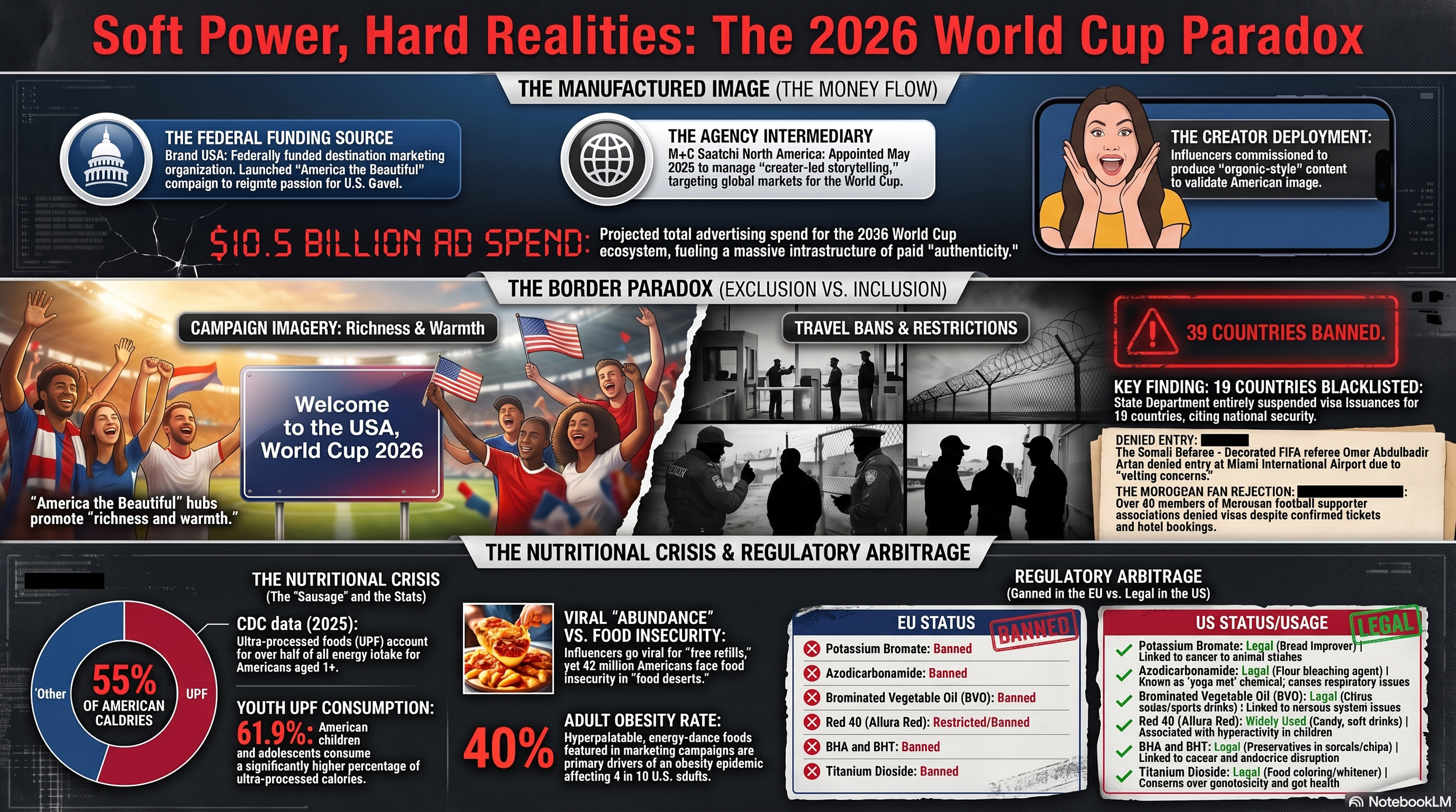
International Soccer Tournament Paradox Infographic
Final Mission Statement: As a literate media consumer, your mission is to see through the manufactured consensus and demand an honest American story—one that interrogates the chemical and financial engineering behind the viral feed.